
30 Jun What are the Differences Between Disc Herniations, Disc Bulges, and Disc Ruptures
Spinal discs are cushions between the vertebrae that absorb shock and allow movement. When a disc is injured or degenerates, several terms describe different stages and severities of disc damage. Though often used interchangeably, understanding the differences—disc bulge, herniation, prolapse, rupture, extrusion, and sequestration—helps clarify diagnosis and treatment options.
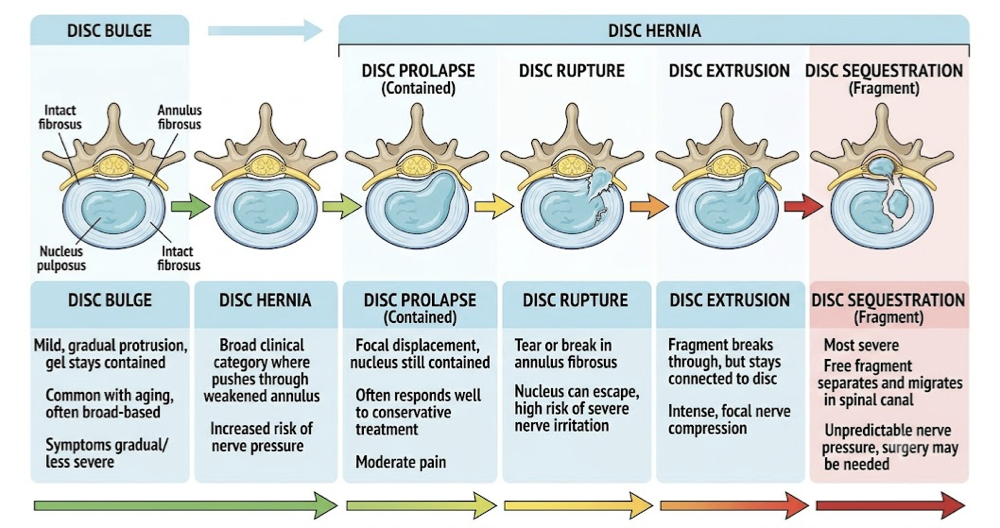
Disc bulge: A disc bulge is a broad, mild outward extension of the disc’s outer layer (annulus fibrosus) beyond the vertebral edge. The nucleus pulposus (the gel-like center) remains contained. Bulges are common with aging and often involve a large portion of the disc circumference. Many people with bulges are asymptomatic; symptoms, if present, tend to be gradual and less severe because the disc material hasn’t escaped to directly compress nerves.
Disc herniation: Disc herniation is a general term indicating that the disc’s inner material has pushed through a weakened area of the outer layer. It’s a broader clinical label covering multiple subtypes (prolapse, extrusion, sequestration). Herniations are more likely than bulges to press on nerve roots or the spinal cord and cause pain, numbness, or weakness along affected nerve distributions.
Disc prolapse: Disc prolapse (sometimes called contained herniation) describes a focal displacement where the nucleus bulges further but remains contained by the outer annulus. The disc material has pushed into the annulus but not broken through it. Pain can be moderate and typically responds to conservative care (physical therapy, medications, injections).
Disc rupture: Disc rupture indicates a tear or break in the annulus fibrosus. This term is often used interchangeably with major herniation stages because once the annulus is torn, the nucleus can escape. Rupture increases the likelihood of more severe symptoms due to direct nerve irritation from exposed disc material and inflammatory chemicals.
Disc extrusion: An extrusion occurs when nucleus material breaks through the annulus but remains connected to the parent disc—imagine a balloon squeezed through a hole but still attached. The extruded fragment can compress nerves or the spinal cord more intensely and may cause sharper, more localized symptoms. Imaging (MRI) often shows a focal displaced fragment.
Disc sequestration: Sequestration is the most severe stage: a free fragment of nucleus material has completely separated from the disc and migrated within the spinal canal. This loose fragment can cause unpredictable nerve compression and inflammation. Sequestrated fragments sometimes require surgical removal, especially if neurological deficits are present.
Think of these terms as a spectrum from mild (bulge) to severe (sequestration). Bulges are broad and contained; herniation covers any breach of internal disc tissue; prolapse is contained bulging; rupture denotes annular tearing; extrusion is displaced but attached material; sequestration is a free fragment. Treatment varies by severity, symptoms, and neurological findings—from conservative care to injections or surgery when nerve function is threatened.
If you’re experiencing neck pain or back pain and other associated symptoms, don’t wait for pain to worsen. The therapists at Buffalo Back Neck and Back Physical Therapy can provide a comprehensive evaluation and develop a personalized treatment plan to help you return to pain-free living. Contact us today to schedule your consultation and take the first step toward better spinal health.
Sorry, the comment form is closed at this time.