
PHYSICAL THERAPY SERVICES

NECK AND BACK PAIN TREATMENT

If you’re dealing with neck or back pain, you’re far from alone. Neck and back problems are the most common conditions we treat, affecting millions of people every day. Whether it’s a dull ache that won’t go away, sharp pain when you move, or stiffness that makes getting through your day a struggle, back and neck issues can seriously limit your lifestyle.


most back and neck problems respond extremely well to the right kind of treatment. You don’t need to accept pain as your new normal or rely solely on medication for relief. Our expert physical therapy targets the root cause of your pain, whether it’s from an injury, poor posture, muscle weakness, or wear and tear over time.

COMMON CAUSES OF NECK AND BACK PAIN

Buffalo Back & Neck creates personalized treatment plans that reduce your pain, restore your mobility, and strengthen your spine to prevent future problems. Our goal is simple: help you get back to living your life without limitation.

Herniated, bulging, compressed, ruptured, slipped. These are the many names for this condition caused by worn-down, degenerated vertebral cushioning. This naturally occurs when the cushioning between vertebral discs leaks out and irritates nerves.


Common Causes of Disc Herniation:

  • Age-related wear and tear
  • Repetitive, spine-stressing activity (especially lifting, bending, twisting)
  • Smoking, excess weight and sedentary lifestyle
  • Sudden injury


Common Signs and Symptoms of Disc Herniation:

  • Numbness and tingling (often radiating into the upper or lower extremities)
  • Pain (local and often radiating into the upper or lower extremities)
  • Weakness
  • Stiffness

Degenerative disc disease is when the cushiony discs between the vertebrae of the spine deteriorate. Without cushioning, the spine experiences additional pressure, causing mild, moderate or severe pain.


Common Causes of  Degenerative Disk Disease:

  • Aging
  • Genetics/heredity
  • Injury
  • Obesity
  • Smoking
  • Trauma


Common Signs and Symptoms of Degenerative Disc Disease:

  • Weakness in either the upper or lower extremities
  • Numbness / tingling
  • Pain
    • Especially low back, buttocks, thighs, neck, and upper extremities
  • Worsens with sitting, bending, lifting, twisting
  • Improves with walking, changing positions, lying down


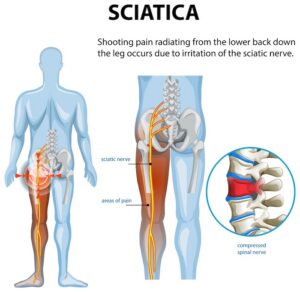
Sudden, sometimes debilitating pain that starts in the low back and radiates down the leg is a telltale sign of sciatica. Sciatica is a condition in which the nerve that runs from the lower back, through the buttocks and down the leg becomes inflamed or irritated.


Common Causes of Sciatica:


Common Signs and Symptoms of Sciatica:

  • Numbness and tingling (often radiating into the upper or lower extremities)
  • Pain (local and often radiating into the upper or lower extremities)
  • Weakness
  • Stiffness


Regional aching and pain in the area between the spine and the buttock can be due to sacroiliac joint inflammation. Often localized to one side of the spine, this form of back pain is often the result of misalignment and instability.

Common Causes of SI Joint Dysfunction:

  • Pregnancy
  • Trauma
  • Leg length discrepancy
  • Gait abnormality

Common Signs and Symptoms of SI Joint Dysfunction:

  • One sided pain in the region between the low back and buttock
  • Tenderness to the region of pelvis below the lower back
  • Aching
  • Stiffness


This condition causes a narrowing of the spine one of three places: the center space, the nerve branch canals or the space between the bones of the spine. This narrowing puts pressure on the spinal cord and nerves, causing a great deal of pain.


Common Causes of Spinal Stenosis:

  • Aging
  • Arthritis
  • Genetics
  • Injuries
  • Scoliosis
  • Tumors


Common Signs and Symptoms of Spinal Stenosis:

  • Cramping
  • Numbness
  • Pain (especially neck, back and radiating down leg)
  • Weakness


When teen or adolescent athletes complain of low back pain, the culprit could be a tiny crack or stress fracture in one of the vertebrae. This condition, called spondylolysis and generally improves with rest and rehabilitation.


Common Causes of Spondylolysis:

  • Genetics/heredity
  • Repetitive bending and straightening
  • Sports injuries (especially football, diving, gymnastics)


Common Signs and Symptoms of Spondylolysis:

  • At times, no obvious symptoms.
  • Feeling of strained muscle
  • Low back pain ranging from sharp to dull ache
  • Pain aggravated by bending and straightening.


Having an “S” or “C” curve in the back is one apparent symptom of a medical condition called scoliosis. This abnormal curvature of the spine can affect anyone at any age, although it is more prevalent in girls than boys.


Common Causes of Scoliosis:

  • Unknown, possibly hereditary
  • Often more pronounced with age especially in women
  • May be secondary to other neuromuscular conditions:
    • Cerebral palsy
    • Muscular dystrophy
    • Spina bifida


Common Signs and Symptoms of Scoliosis:

  • Asymmetrical, elevated hip
  • Distinct sideways lean
  • Noticeable hump
  • Protruding, asymmetrical shoulder blades
  • Uneven shoulder or waist line


Although people may joke about this condition in response to a mild injury, whiplash is a real condition. It occurs when soft tissues of the neck are strained or sprained, usually as a result of sudden forward or backward motion.


Common Causes of Whiplash:

  • Motor vehicle accidents (especially rear-end collision)
  • Acute injury (falls or sudden force to the head or neck)


Common Signs and Symptoms of Whiplash:

  • Pain


Neck and Back Pain Physical Therapy Buffalo

FROM THE "BACK IN MOTION" BLOG

Sciatica Treatments | Buffalo Back & Neck

Beyond the Back: Surprising Causes of Sciatica Not Found in the Lumbar Spine

When you feel that unmistakable lightning bolt of pain searing from your glutes down to your toes, the first suspect is almost always a herniated disc. While lumbar spine issues account for roughly 90% of sciatica cases, the remaining 10% present a diagnostic puzzle. If your MRI shows a perfectly healthy lower back but your leg is still screaming, it’s time to look at extraspinal causes—the “sciatica mimics” that originate outside the vertebral column.

Read More »