
15 Jan Beyond the Back: Surprising Causes of Sciatica Not Found in the Lumbar Spine
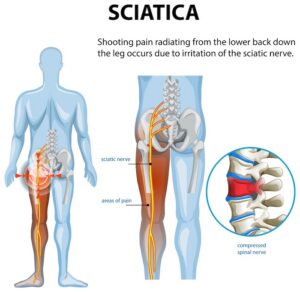
When you feel that unmistakable lightning bolt of pain searing from your glutes down to your toes, the first suspect is almost always a herniated disc. While lumbar spine issues account for roughly 90% of sciatica cases, the remaining 10% present a diagnostic puzzle. If your MRI shows a perfectly healthy lower back but your leg is still screaming, it’s time to look at extraspinal causes—the “sciatica mimics” that originate outside the vertebral column.
The Gluteal “Grip”: Piriformis Syndrome – The most famous non-spinal culprit is piriformis syndrome. The piriformis is a small, pear-shaped muscle deep in the buttocks that sits directly over the sciatic nerve. While this occurs much less frequently than previously thought, if this muscle spasms, tightens, or hypertrophies due to overuse or injury, it can literally strangle the nerve.
Interestingly, approximately 17% of the population has a sciatic nerve that pierces the piriformis muscle rather than passing beneath it, making them more susceptible to this type of irritation.
The “Walletitis” Phenomenon – Believe it or not, your back pocket might be the problem. Often called “wallet sciatica” or “credit-card-wallet neuritis,” this occurs when sitting on a thick, bulky wallet for long periods compresses the sciatic nerve against the pelvis. The solution is often as simple as a “walletectomy”—moving your wallet to a front pocket.
Pelvic Joint Disruptions – The Sacroiliac (SI) joint connects your spine to your pelvis. When this joint becomes inflamed (sacroiliitis) or moves excessively (hypermobility), it can release inflammatory mediators or tighten the surrounding muscles, both of which can irritate the nearby sciatic nerve.
Pregnancy and Gynecological Factors – Sciatica is common during pregnancy, but it isn’t always about the spine. As a fetus grows, the fetal head may compress the sciatic nerve or the lumbosacral plexus within the pelvic rim.
A rarer but fascinating cause is Cyclical Sciatica (catamenial sciatica). In women with endometriosis, endometrial tissue can sometimes grow on or around the sciatic nerve. This causes severe leg pain that flares up specifically in sync with the menstrual cycle.
Vascular and Metabolic Triggers – Sometimes, what feels like nerve compression may be due to reduced blood flow or hyperglycemia.
Vascular Issues – An aneurysm in the iliac artery or peripheral artery disease (PAD) can reduce blood flow to the leg muscles, causing pain that mimics sciatica.
Diabetes – High blood sugar can lead to diabetic peripheral neuropathy, damaging the sciatic nerve directly without any physical pressure from a disc.
Why the Distinction Matters
Treating a piriformis problem with spinal surgery won’t help; in fact, it could make things worse. If your leg pain is accompanied by night sweats, unexplained weight loss, or cyclical timing, it is crucial to consult a specialist for a pelvic or neurological workup beyond a simple spine X-ray.
If you’re experiencing sciatica that may or may not be stemming from your lower back, don’t wait for symptoms to worsen. The therapists at Buffalo Back Neck and Back Physical Therapy can provide a comprehensive evaluation and develop a personalized treatment plan to help you return to pain-free living. Contact us today to schedule your consultation and take the first step toward better spinal health.
Sorry, the comment form is closed at this time.