
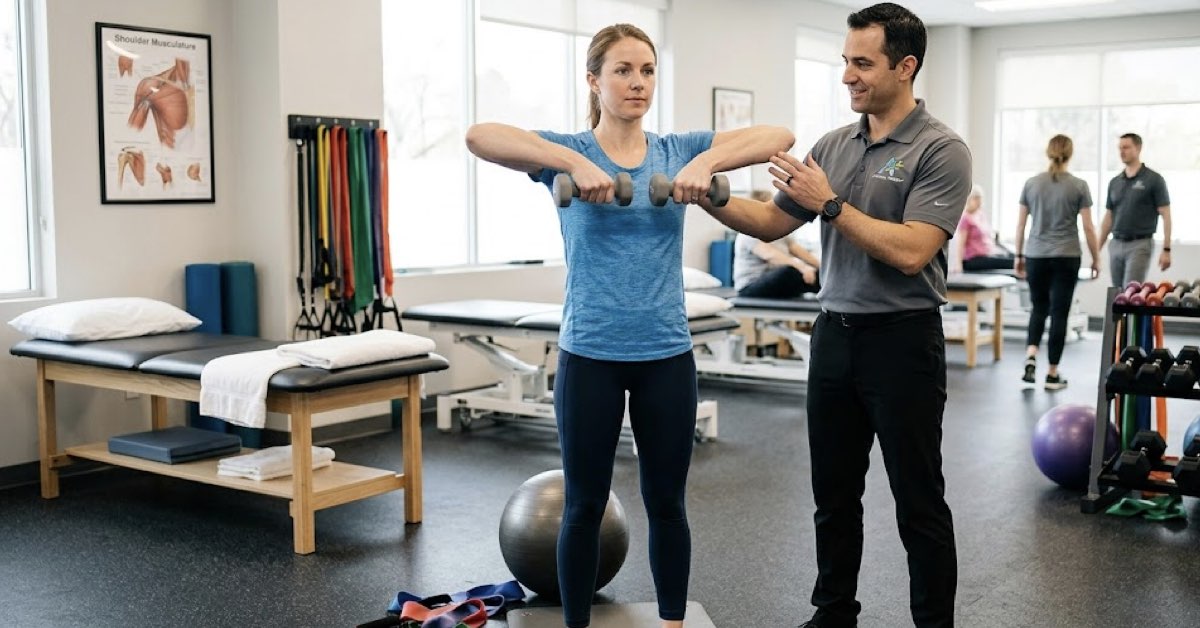
09 Oct Strengthening Exercises for Rotator Cuff Tears
Once your range of motion improves, treatment moves toward strengthening your shoulder joint. A rotator cuff tear won’t heal on its own, but building up surrounding muscles takes some stress off the injured area. The process needs to be slow and progressive. There’s the potential for a small tear to become a larger tear. Don’t push through the pain with the idea that it’s adding strength. You may do more harm than good. If your range of motion has returned in your shoulder, consider these strength-building moves.
Standing Shoulder Row
You will need an elastic exercise band for this maneuver. This exercise helps build a solid base for your rotator cuff. Attach the band to a door or some other sturdy spot. While standing, hold the band with both hands. Move back until your elbows are straight and there’s slight tension in the band. Pinch your shoulder blades while slowly pulling back on the band. Bend your elbows as you pull, keeping your arms close to your body. Your goal should be to get your elbows to a 90-degree bend, with your forearms parallel to the floor. Return to starting position. Repeat five times.
V Arm Raise
This exercise will engage the greatest number of muscles in her shoulder girdle while also being safe to perform.
Begin in a standing position. Stretch out your arms and bring your hands together to create a V shape. Keep your thumbs pointed up. Slowly raise your arms up the ceiling, maintaining the V shape. (Just lifting the weight of your arms is enough at the start. Later, feel free to add a 1- or 2-pound weight, or pull a can out of the pantry.) Return to the starting position. Repeat five times.
Wing Flap
This exercise starts with just using body weight. Once you can do it easily and without pain, consider holding a 1 or 2 pound weight. Lie on your side, with your uninjured shoulder down and your injured shoulder up. Your injured arm should be resting on your body, with your elbow bent at 90 degrees. Rotate your arm up toward the ceiling, keeping your elbow bent. (Be careful not to go too far. Aim for creating no more than a 60-degree angle with your arm.) Return to your starting position. Repeat 10 times.
If you’re experiencing shoulder or rotator cuff pain or suspect you may have a shoulder issue, don’t wait for symptoms to worsen. The therapists at Buffalo Back and Neck Physical Therapy can provide a comprehensive evaluation and develop a personalized treatment plan to get you back to living pain-free. Contact them today to schedule your consultation and take the first step toward better health.
Sorry, the comment form is closed at this time.