
12 May Finding Your Way Back: The Road to Recovery from a Lumbar Disc Herniation
If you’ve ever felt that sudden, sharp zap down your leg or a dull, nagging ache in your lower back that just won’t quit, you know how quickly a disc herniation can shrink your world. It changes how you sit, how you sleep, and even how you interact with your family.
The good news? Your body is remarkably resilient. While a herniated disc sounds intimidating, it doesn’t have to mean a permanent “new normal” of pain. Physical therapy is widely considered the gold standard for getting you back on your feet—not just by masking the symptoms, but by addressing the mechanics of how you move.
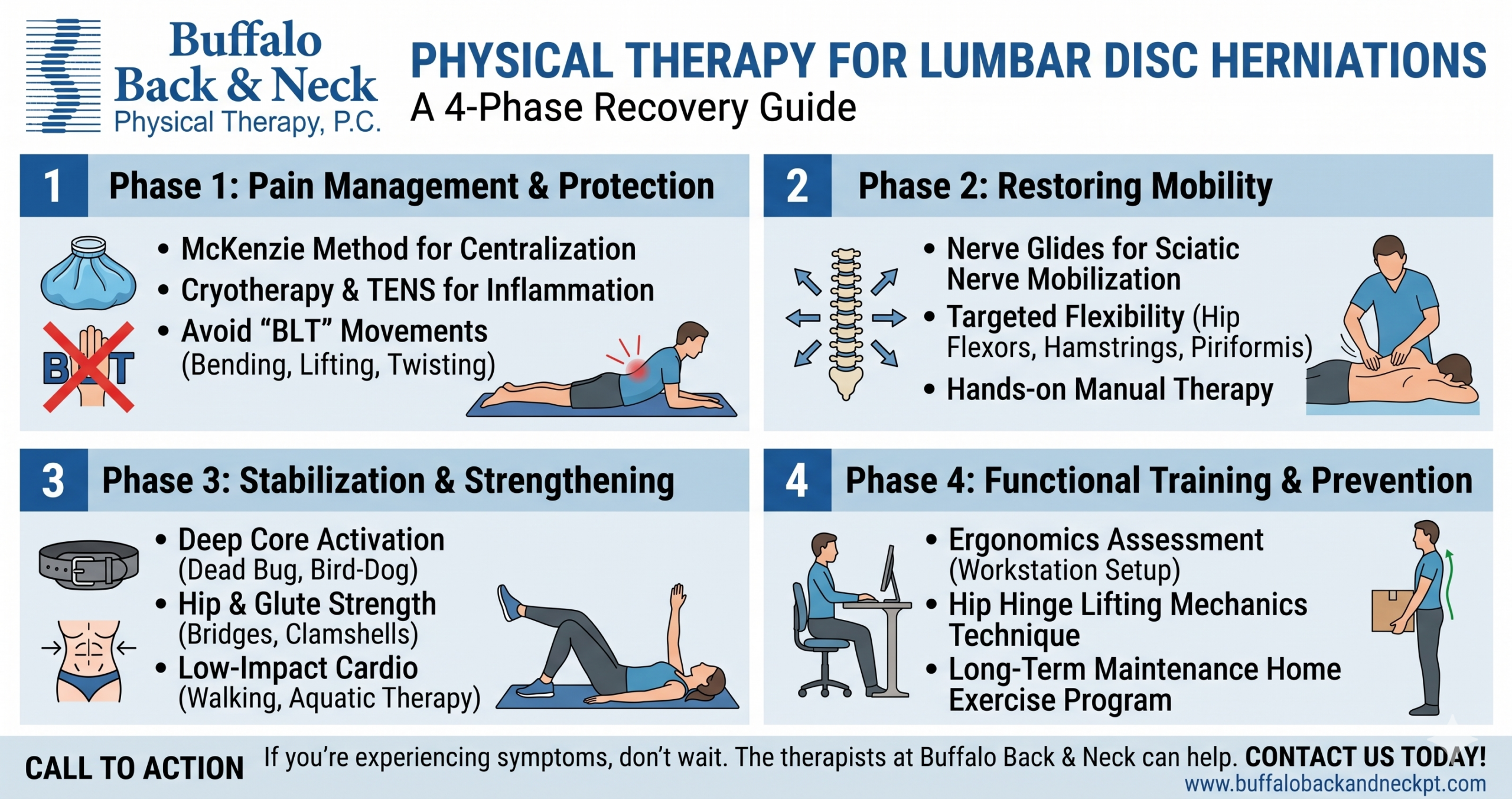
Here is a look at the typical journey we take together at Buffalo Back & Neck Physical Therapy to help you move from “ouch” to active.
Phase 1: Finding the “Quiet”
In the early days, your nervous system is on high alert. Our first priority isn’t a heavy workout; it’s about calming the inflammation and finding positions that provide relief.
We often use the McKenzie Method to identify a “directional preference.” This is a specific movement—often a gentle back extension—that helps “centralize” your pain. If we can move the pain out of your leg and back toward your spine, we know we’re on the right track. This phase is all about protection and learning which movements to temporarily avoid so your body can begin the healing process.
Phase 2: Restoring the Flow
Once the sharpest pain begins to settle, we focus on mobility. A disc injury can make your muscles tight and your nerves “sticky.”
We use Nerve Gliding—think of it as floss for your nerves—to ensure the sciatic nerve moves smoothly without getting caught on scar tissue. We also look at the “neighbors” of your lower back. By improving flexibility in your hips and mid-back, we ensure your lumbar spine isn’t doing more than its fair share of the work.
Phase 3: Building Your Natural “Corset”
This is where the transformation happens. To prevent future injuries, we help you build a “muscular corset” around your spine.
Instead of traditional sit-ups (which can actually stress a disc), we focus on Deep Core Activation. Exercises like the “Bird-Dog” or “Dead Bug” teach your body to stay stable while your limbs move. We also focus heavily on the glutes—your body’s primary engines—to ensure they are doing the heavy lifting during your daily life.
Phase 4: Back-Proofing Your Life
The final step is making sure you feel confident returning to the things you love, whether that’s lifting your grandkids, heading back to the gym, or sitting through a long flight.
We’ll dive into Functional Training, perfecting your “hip hinge” so you can lift objects safely and reviewing your workstation setup to keep your spine supported. Our goal is to graduate you with a toolkit of exercises and habits that keep you in the driver’s seat of your own health.
Don’t Let Back Pain Call the Shots
You don’t have to “just live with it” or wait for the pain to become unbearable before seeking help. Whether you’re at the start of your recovery or you’ve been struggling for months, a personalized plan can make all the difference.
Ready to get back to pain-free living? Contact Buffalo Back & Neck Physical Therapy today to schedule your evaluation. Let’s build a plan that gets you moving again.
Sorry, the comment form is closed at this time.