
Spondylolysis or lumbar stress fracture is a stress fracture of a section of the lumbar spine. The area of the fifth lumbar vertebra is most often affected. The injury can occur on the left or right of the vertebra. Lumbar stress fractures occur in up to 11.5% of the general population in the United States. It is a common cause of low back pain in older children and youth. It most commonly occurs in males, but it can also occur in females.
Highly active adolescents who engage in activities such as lifting heavy loads, repeated backward bending, or trunk twisting are at the greatest risk. Activities such as football, hockey, gymnastics, and dance increase the risk of injury. Only a small percentage of cases require surgery. The majority (85%-90%) of young patients recover within three to six months with appropriate treatment. Recovery time can be longer and varies among individuals.
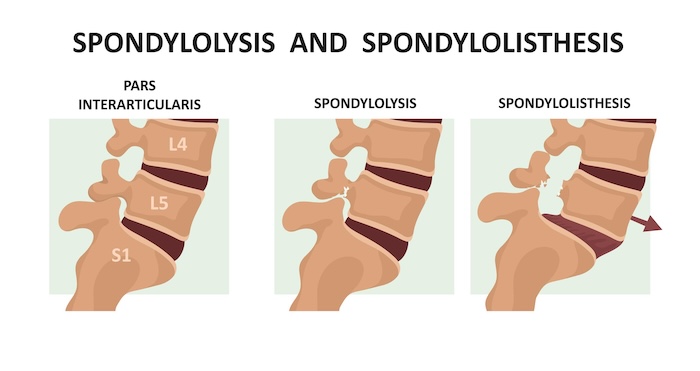
Spondylolisthesis or slipped vertebra, is a condition that involves the forward slippage of one vertebra over the one under it. If a crack or stress fracture occurs on both sides of the vertebra, it is called spondylolisthesis. Lumbar stress fracture and slipped vertebra are often described together because they are similar in:
- The mode of injury
- Age of the patient
- Symptoms
- Treatment
Physical therapists help people with these conditions recover and safely return to daily activities, work, and sports. Physical therapists are movement experts. They improve quality of life through hands-on care, patient education, and prescribed movement. You can contact a physical therapist at Buffalo Back and Neck Physical Therapy directly for an evaluation.
What are stress fractures and slipped vertebrae of the lumbar spine?
A lumbar stress fracture is a fracture of the part of the bony ring that connects the front part of the spinal column to the back part. The fracture occurs between the part of the bone that sticks out of the back of the spine and the part that sticks out of the side of the spine. Doctors sometimes refer to this condition as a defect. Strain of the lumbar spine from repetitive activities in a growing child can cause this type of injury. It results in low back pain.
Slipped vertebra is the forward slip of a defective, unstable vertebra. There are five grades of slips, with grade I denoting the smallest amount of slippage and grade V denoting 100% slippage. With milder slippage, and a defect on just one side of the vertebra, physical therapy treatment is effective. Young athletes whose teenage growth spurt has not yet occurred are at greater risk for continued slippage. These athletes and are monitored until they are fully grown.
Key points to understand about lumbar stress fracture and slipped vertebra:
- Early detection and proper diagnosis of these conditions are important. Withearly diagnosis and treatment, people with these conditions can safely return to sport or an active lifestyle. If symptoms persist and you wait to seek help, healing may take much longer.
- Most symptoms can resolve with rest and physical therapy.
- Surgery may be needed when treatment of more than six months fails, and symptoms persist.
- Both of these conditions need to be ruled out in a young athlete who is has low back pain that lasts for more than a few weeks. Active young athletes in sports such as football, hockey, gymnastics, and dance are at the greatest risk. This is especially true while the athlete is still growing.
- If an X-ray does not show a fracture, but a clinical exam suggests a high likelihood of lumbar stress fracture, your doctor may order an MRI to rule it out.
- These conditions are not a major cause of low back pain in adults. It can, however, occur among elite adult athletes who participate in high-risk sports.
Signs and symptoms of spondylolysis and spondylolisthesis
- Lumbar stress fracture or slipped vertebra may be present if you experience:-
- Low back pain with or without buttock or leg pain. If leg pain is present, it is felt in the thigh, but generally not below the knee.
- Muscle spasms in your low back, buttocks, and thighs.
- Difficulty or pain with walking or standing for long periods.
- Symptoms that are relieved by sitting, slouching, or bending forward.
- Pain with sports or manual labor.
- Pain with bending backward, twisting the spine, or throwing.
- Decreased flexibility of the leg muscles.
If you’re experiencing back pain or suspect you may have lumbar spondylolysis or spondylolisthesis, don’t wait for symptoms to worsen. The therapists at Buffalo Back Neck and Back Physical Therapy can provide a comprehensive evaluation and develop a personalized treatment plan to help you return to pain-free living. Contact us today to schedule your consultation and take the first step toward better spinal health.
0 Comments